Lifting systems – more options for wastewater drainage
Your home, your way!
An additional bathroom, an extra kitchen or even a complete granny flat in the basement – would you like to make better or additional use of existing rooms, but the wastewater connections do not fit your plans?
With a suitable lifting station, facilities such as a toilet, shower, washbasin, kitchen sink or washing machine can also be drained below the backflow level. A lifting station can therefore provide the technical basis for additional ways of using these spaces.
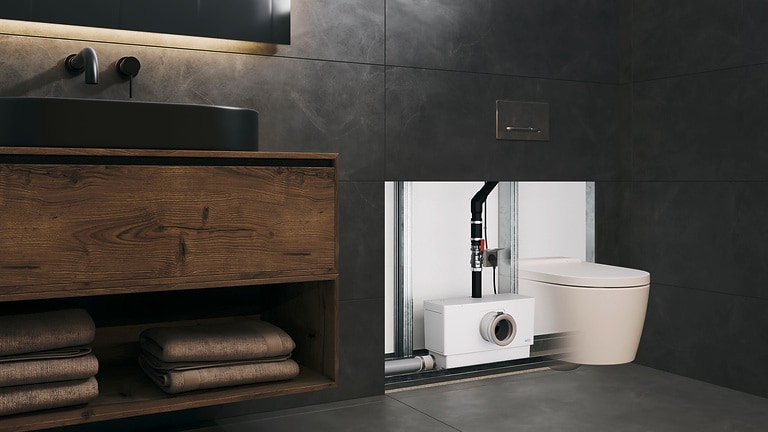
Lifting stations are used where wastewater cannot drain away by gravity, for example in basements or other areas below ground level. They collect the wastewater and pump it into the drainage pipework.
Compact and flexible lifting systems for your home
Installing a lifting system can sometimes be a challenge – limited space, existing pipes, and unique structural conditions must all be taken into account. Our small lift stations are designed with this in mind.
Thanks to their compact dimensions *and versatile connection and installation options, they offer flexible integration into existing wastewater systems and can thus be adapted to a variety of spatial conditions. Another advantage: Our lift stations are designed to be installed with minimal effort. Our recommendation: contact your qualified plumbing and heating installer to find the most suitable lifting system or lifting station for your home.

Wilo-DrainLift MINI5-XS/WC
Lifting unit with toilet connection for drainage of single rooms
More comfort for your home
Features
- Reduced risk of blockages: The pump features a rotating cutter that can break down solids in the wastewater.
- Flexible installation: The discharge connection can be positioned horizontally or vertically to suit the installation.
- Audible high-water alarm: If the water level in the tank becomes too high, the integrated buzzer emits an audible warning signal.
Highlights
- Smart Home Ready: The potential-free contact allows the alarm signal to be transmitted to an external alarm system or compatible smart home system.
- Easy access to the pump unit: The pump unit is removable and features a handle to facilitate removal.

Wilo-DrainLift MINI5-XS/C
Lifting unit for drainage of a single room
More comfort for your home
Features
- Selectable discharge port – horizontal or vertical
- Audible high-water alarm: If the water level in the tank becomes too high, the integrated buzzer emits an audible warning signal.
- Also suitable for condensate: The lifting station can pump condensate with a pH value of 2.5 or higher, provided it is mixed with wastewater from an additional inlet.Highlights
Highlights
- Smart home ready
- Easy access to the pump unit: The pump unit is removable and features a handle to facilitate removal.

Wilo-DrainLift MINI3-XS/WC
Lifting unit with toilet connection
for drainage of single rooms
Versatile
Features
- Reduced risk of blockages: The pump features a rotating cutter that can break down solids in the wastewater.
- Depth suction – up to 30 mm
- The lifting unit can be connected to a toilet either from the side or the front
Highlights
- Various connection options for inlets and drains

Features
- Depth suction – up to 25 mm
Highlights
- Various connection options for inlets and drains

Wilo-DrainLift MINI3-XXS
Lifting unit for drainage of one washbasin or shower
For the smallest room
Features
- Fits in the tightest space – 300 mm wide, 166 mm deep
Highlights
- Various connection options for inlets and drains
- Compact design

Wilo-DrainLift SANI CUT-S
Lifting unit with toilet connection for drainage of multiple rooms (such as, e.g., a basement apartment) or of an entire building
Compact size, maximum power
Features
- Larger pump unit for increased volume, featuring a macerator that effectively shreds solids with a double shear effect.
- Transparent cleaning opening for easy maintenance
- Flexible connection options make installation easy
Highlights
- Low overall installation costs
- Integrated non-return valve
Find the right lifting system for your home
With our practical selection table, you can find out which wastewater lifting station suits your requirements. Take into account:
- Installation location: How much space do you have? Do you need a solution for a single room or the whole house?
- Type of wastewater: Is it grey water (shower, washbasin) or black water (toilet)?
- Flow head & volume: What power does your wastewater lifting station need in terms of maximum head and wastewater volume?
- Connection points: Which appliances / sanitaryware items should be connected (e.g. toilet, washing machine, dishwasher)?

Find a qualified installer nearby!


How does a lifting station for wastewater work?
A lifting system enables the efficient removal of wastewater if the building or room is located below the backwater level, such as cellars or basement apartments.
The lifting station collects the wastewater and then pumps it into the wastewater system.
Here are the most important steps:
- Water collection: Waste water from the toilet, shower or washbasin flows into the collection tank.
- Level control: Sensors measure the water level in the collection tank.
- Pump starts: As soon as the tank is full, the wastewater is pumped into the drain pipe or pressure pipe.
- Check valve: Prevents the pumped wastewater from flowing backwards.
- Ventilation: An activated carbon filter ensures that no unpleasant odours occur in small lifting systems. This is provided that it has been installed properly and is replaced regularly. In larger pumping systems, a properly installed vent line that runs over the roof ensures odor-free venting.
When is a lifting station for wastewater necessary?
A pumping system is often necessary whenever the building or the relevant rooms are located below the backflow level. This is the case, for example, if you want to use your basement as a living space and install sanitary facilities there. In the case of conversions where there are no sewage pipes, a small lifting system helps to drain the wastewater. If installed in accordance with the relevant standards, the system can help to protect against backflow from the sewer system; it does not provide blanket protection against flooding or all routes of water ingress. You can find more specific application situations for lifting systems in the wastewater sector in the insights section "Defying gravity with lifting systems: comfort and flexibility for your home".
When do I need a lifting system for single-room drainage, and when do I need it for several rooms?
A lifting system for individual room drainage is used when only one room is to be made suitable for sewage. This is the case, for example, in a single bathroom or toilet in the basement. For the drainage of several rooms or entire buildings, a larger lifting station is required. This can collect wastewater from different sources in different rooms, such as toilets, kitchen sinks or laundries, and pump it out
FAQ macerator wastewater lifting system
What types of wastewater are lifting systems suitable for?
Does a lifting station need maintenance?
Our MINI-series wastewater lifting units require only regular cleaning and filter replacement, making them virtually ‘maintenance-free’. For our SANI lifting systems, on the other hand, we recommend regular maintenance by a specialist company in accordance with the DIN EN 12056 standard to ensure smooth operation and a long service life.
Which lifting system do I need if my basement has a toilet?
What happens if the lifting station fails?
A failure can lead to sewage backwater, moisture damage, mould growth, and unpleasant odours. The specific risk depends on the design of the plant and the building.
For small lifting systems, we recommend regular cleaning and replacement of the activated carbon filter (see also Installation and operation management, maintenance intervals according to DIN EN 12050-3). For larger lifting systems (such as the Wilo-DrainLift SANI series), the system is vented with a ventilation pipe (in accordance with DIN EN 12050-1), and we also recommend maintenance in accordance with our installation and operating instructions.