



















































































Airports are critical infrastructure that require continuous operation
For many people, the airport is the starting point for essential business trips, or special moments and personal highlights of the year. Holidays often start at the airport, with anticipation and excitement before departure; the airport becomes part of the experience.
For these moments to be possible, airport infrastructure must be designed for high availability and applicable safety requirements..
Airports are much more than just runways
Many locations have grown into extensive airport cities with office buildings, hotels, shopping centres, and a variety of building types in the vicinity. Behind every trouble‑free operation is a technical infrastructure designed to support supply, comfort, and operational safety.
Some airport locations are characterised by evolved structures with outdated technology. Extensions and modernisations, in these cases, can only be carried out step by step and during ongoing operations.
At the same time, requirements relating to energy use, drinking water hygiene, fire protection and resilience are increasing. Energy consumption and emissions are also coming under greater scrutiny and increasingly need to be transparently recorded and assessed.
Technical solutions can help implement the objectives of the respective airport strategy and address relevant requirements of certification systems such as LEED or DGNB. System planning tailored to actual demand can also help reduce water consumption.

Optimise systems now
Would you like to modernise existing systems, integrate new areas, or identify potential for improving energy efficiency in your infrastructure in a targeted way?
We support you – from analysis through to operation.
Integrated solutions for airport operations
We view airports as interconnected systems comprising a wide range of buildings and uses. Terminals, technical facilities, multi-storey car parks, office spaces and hotels all have their own requirements for supply, climate control, drainage and safety. Our solutions cover all key areas of water management and building services – from water supply, heating, cooling and air conditioning to drainage and fire water supply at the airport.
Whether individual terminal areas are being modernised, buildings extended or existing systems upgraded, modular systems enable a step-by-step approach and can be integrated into existing building management systems. This makes it possible to assess energy and water consumption and identify potential for optimisation – tailored to the specific requirements for supply, safety and comfort.
More than technology: partnership over the entire lifecycle
We support airport projects from the early concept phase through design, installation, and commissioning to maintenance, optimisation, and digitalisation. We draw on our experience from complex airport projects and always develop customised solutions for diverse building structures – even where space is limited, security requirements are high, and operations are ongoing. Digital solutions for remote monitoring and control also support centrally monitored and more predictable airport operations.
Our highlight applications for airports
Combining a wide variety of uses in a limited space needs specialist support. Our solutions are configurable for typical airport operating requirements.
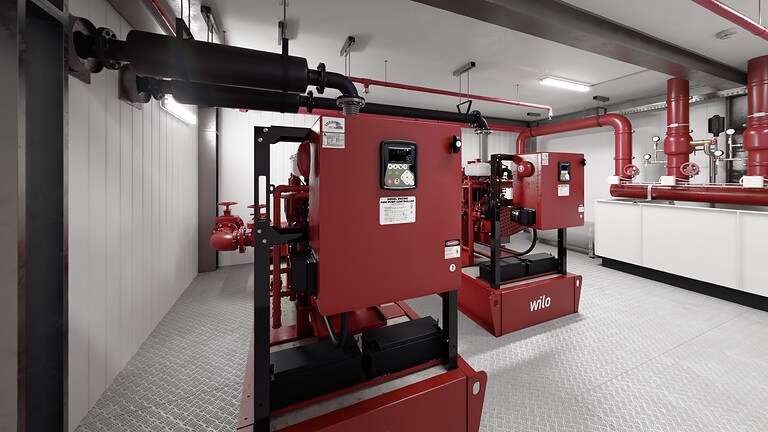
Firefighting
Designed for emergencies
Fire protection places high demands on an airport’s technical infrastructure. Fire water systems are designed to provide the required volume of fire water and meet the standards relevant to the respective configuration.
- Redundant pump systems can support operational reliability in terminals, multi-storey car parks and technical areas, depending on project requirements
- Systems for separating fire water and drinking water
- Transparent monitoring and documentation of relevant operating and inspection statuses

Wastewater collection and transport
Drainage for large airport areas
Large apron, roof and car park areas, as well as heavy rainfall events, place particular demands on airport drainage systems.
- Designed for project-specific water volumes
- Designed for continuous system operation
- Support for backflow and emergency concepts
- Adaptation to complex existing pipework networks

Water distribution and boosting
Stable pressure conditions with changing water demand
Whether in terminals, hotels or office buildings, water demand can vary considerably depending on use, time of day and passenger numbers. Pressure-boosting systems support demand-based water supply and stable pressure conditions across different areas of the building.
- Adaptation to changing water demand
- Flexible solutions for established and heterogeneous building structures
- Integration into technical plant rooms, even where space is limited
- Designed to meet the relevant drinking water hygiene requirements

Drinking water hygiene
Actively counteracting stagnation
Terminals, lounges and other areas of airport buildings are used at different times and with varying levels of intensity. This places particular demands on drinking water installations and hygienic operation.
- Drinking water circulation to support temperature maintenance and reduce stagnation
- Demand-based flushing cycles to ensure targeted water renewal in less frequently used areas
- Solutions for extensive pipework networks
- Operating data for greater transparency in operation and maintenance

Heating, ventilation, and air conditioning (HVAC)
Flexible systems for different areas of use
Fluctuating passenger numbers, different usage zones and long operating hours place high demands on heating, cooling and air conditioning. Controllable pump and system technology supports demand-based supply to the different areas of the building.
- Supply to terminals, lounges and office areas
- Adaptation to changing load requirements
- Separation of heating and cooling networks
- Solutions for new builds and modernisation projects
- Integration into existing building management systems
Wilo solutions in airport operations
Wilo is used at numerous airport locations worldwide and has extensive experience in modernising complex airport infrastructure.

Václav Havel Airport Prague, Czechia
Prague’s Václav Havel International Airport is one of the most important transport hubs in Central Europe and is located around 17 kilometres west of the city centre. Between 2019 and 2023, extensive modernisation work was carried out in heating, cooling, water supply, and wastewater technology while the airport remained in operation.
Wilo pump and system solutions were used as part of the modernisation project. Controllable pump systems adapt their performance to the respective demand, supporting demand-based system operation across the different applications.
The modernisation upgraded the technical infrastructure in key areas of the airport and adapted it to the requirements of ongoing operations.

Timișoara Airport, Romania
With the opening of the new Schengen terminal in early 2024, Timișoara Airport expanded its facilities to meet growing requirements for capacity, safety and efficiency. Covering an area of around 12,000 m², the terminal is equipped with modern passenger-handling and security technology to support smooth day-to-day operations.
Wilo pump solutions are used in key areas of the building services. In the heating and air-conditioning systems, speed-controlled single and twin-head pumps support demand-based system operation.
In addition, pressure-boosting systems support the supply of water to sanitary facilities and the operational readiness of the fire water systems. The technical design is therefore tailored to the terminal’s safety requirements and supports the long-term operation of its technical infrastructure.
Reliable support for airport operations
Stable operation does not end with commissioning. Our services are monitored over the long term and made transparent for potential energy optimisation – even under the special requirements of this critical infrastructure.

Digital solutions
Control pumps intelligently, connect systems and make operating data visible – for greater transparency and targeted optimisation of system operation.
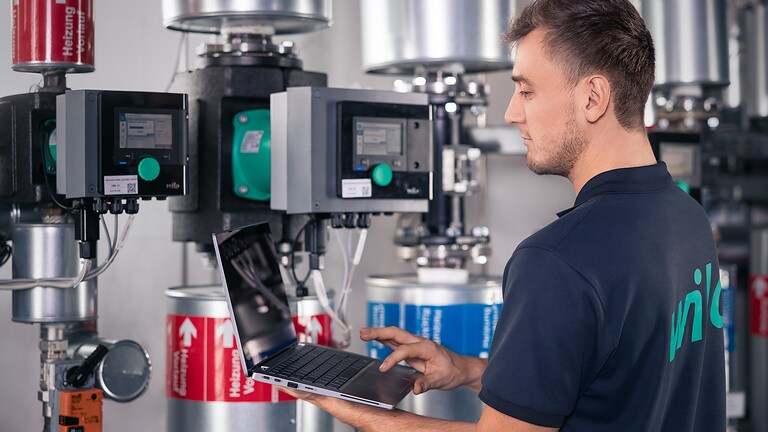
Energy Solutions
Identify energy-saving potential, analyse operating data and derive suitable measures for energy-conscious system operation.
So that journeys can begin
Holidays. Business trips. Annual highlights.
Airports are the starting point for important moments in life. They make possible what people look forward to for a long time, what they plan, what they dream of, and what they need to do for their job. When an airport works, a journey begins. When it does not, everything comes to a standstill.
For these moments to happen, you need technology that works reliably in the background. Wilo pump and system solutions perform key tasks within this infrastructure – from water supply and air conditioning to drainage and fire protection. Digital solutions also provide transparency into operating, energy and consumption data and help identify potential for optimisation.
In this way, we support the technical infrastructure that makes airport operations possible day after day. For people on their way to their destinations. And for places that connect.

FAQ | Frequently asked questions about solutions for airports
How can pump and building services systems be modernised during ongoing airport operations?
Airport modernisation projects are usually carried out step by step and with the aim of minimising operational interruptions and maintaining functionality project-by-project. This requires modular systems that can be flexibly integrated into existing structures. Careful planning, tailored to operating times, safety requirements, and individual building areas, makes it possible to renew or optimise the technology while the airport remains fully functional.
What role does energy efficiency play in the modernisation of airport facilities?
Energy efficiency can be an important approach for addressing operating costs and defined sustainability goals depending on the facility. Especially in existing facilities, significant savings potential can be assessed on a project-specific basisthrough optimised control, demand‑based operation, and the replacement of inefficient technology. The decisive factor here is not only the individual components, but also the interaction within the entire building services system.
How is operational reliability ensured for critical applications such as fire-fighting water or drinking water?
In safety‑critical areas, availability and reliability are paramount. Redundant system concepts, clear separation of drinking water and firefighting water, and regular testing and maintenance processes are essential. In addition, transparent operating states and structured documentation can help make operating states more transparent and indicate maintenance needs at an early stage.
How can airports save water and make good use of rainwater?
Saving water is becoming increasingly important at airports, particularly due to large areas, high user numbers, and growing requirements for documented water and resource management. Smart water distribution, demand‑based control, and the targeted use of rainwater for suitable applications may open water-saving potential depending on system design.
Rainwater can be used, for example, for irrigation of green spaces or as service water. In addition, automated, demand‑based flushing cycles can reduce drinking-water use compared with fixed flushing routines under suitable conditions. Controlled systems can help make consumption and potential water losses more transparent.
Are the solutions also suitable for older terminals and buildings?
Yes. Evolved airport sites benefit from modular, adaptable systems. These can be adapted to different building types, space conditions, and technical standards. In this way, even older facilities can be modernised step by step and brought into line with current technical requirements for efficiency, hygiene, and safety.
How can sustainability goals such as Net Zero Airport or building certifications be supported?
What advantages do digital solutions offer in airport operations?
Digital solutions for remote monitoring provide operating and consumption data that can support operational planning.
They can provide indications of maintenance needs and support operational decisions with data, and gradually further develop systems. These topics are discussed separately on this page.
Get advice now
Whether you are looking to modernise, expand, or optimise your existing facilities, we can help you find the right solution for your airport.
Contact our experts