


















































































Fluctuating resources, rising demands
Ground water is one of the most valuable freshwater resources on our planet. It ensures the drinking water supply, enables agricultural irrigation, and is indispensable for industrial processes. At the same time, the underlying conditions are changing noticeably: longer and irregular dry periods are causing groundwater levels to fall, while water demand rises disproportionately during heat waves. Intake systems must therefore need not only to cover average demand, but also to be prepared for peak loads at any time.
Fluctuating groundwater levels also have a direct impact on delivery head, energy consumption, and the efficiency of wells - both seasonally and over many years. The challenges in extracting surface water from rivers, lakes and impounding reservoirs are also increasing. Water levels and raw water quality are subject to greater fluctuations, while inputs from agriculture, industry or heavy rainfall events significantly affect drinking water treatment.
At the same time, European legislation such as the Water Framework Directive, the Groundwater Directive and the Drinking Water Directive sets requirements for the protection and management of water resources as well as for water quality. Transparent operational and water data can provide an important basis for monitoring, documentation and targeted system operation.

Secure your water abstraction
Together, we develop a solution tailored to your operational requirements, providing cost transparency and supporting reliable system operation over the long term.
Contact our expertsOur solutions for raw water intake
Groundwater and surface water present different requirements for water abstraction. That is why we develop solutions tailored to the specific water source and the requirements of your project.
Groundwater intake
Forward-thinking water abstraction
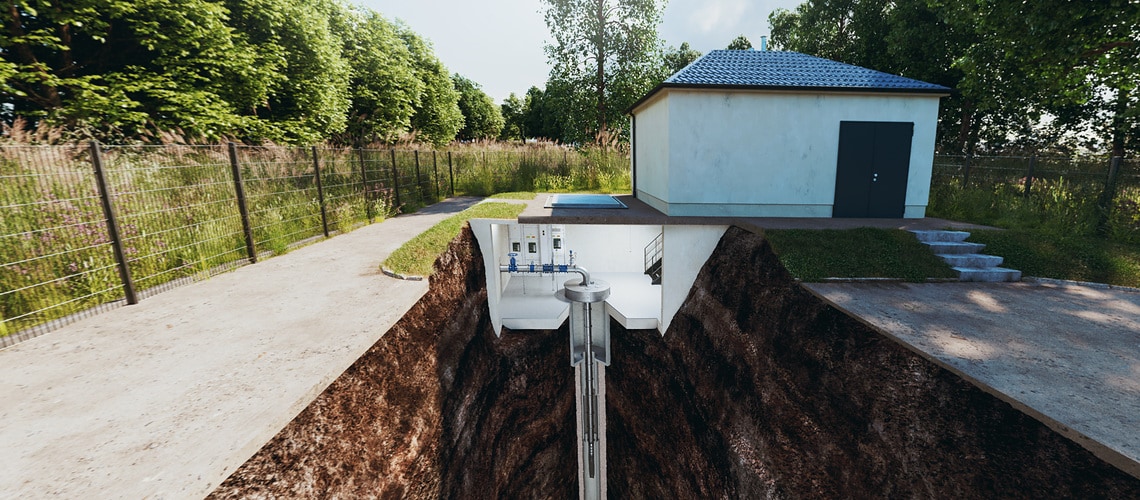
Ground water is a hidden resource - seemingly constant, yet actually sensitive to climate change and growing demand. Fluctuating groundwater levels and increasing intake volumes now require more than traditional pumping technology.
We see groundwater intake as a holistic task. Our objective is clear: stable pumping performance, even under changing conditions.
At the heart of our solutions are borehole pumps such as the Wilo-Actun ZETOS for water abstraction from deep wells. Designed for continuous operation, they can be adapted to different pumping conditions and water levels. With a pump efficiency of up to 86%, the Wilo-Actun ZETOS supports energy-conscious system operation.
Your benefits at a glance:
- For demanding pumping conditions: Designed for continuous operation and, depending on the version, suitable for sand content of up to 150 g/m³.
- Designed for durability: Corrosion-resistant hydraulics made of precision-cast stainless steel, optionally available in duplex stainless steel.
- Suitable for deep wells: The compact design enables use even in deep boreholes.
- Keeping energy demand in focus: A pump efficiency of up to 86% provides a strong basis for energy-conscious operation.
- Adaptable to changing demand: Speed control allows the flow rate and pressure to be adjusted to different operating conditions.
- Transparent operation monitoring: Selected operating data can be integrated into monitoring and control systems.
At the same time, we look beyond groundwater abstraction alone. In regions with documented water scarcity, we support project-specific concepts for groundwater recharge using appropriately treated water, as well as the decentralised use of greywater and rainwater – for example, for irrigation, toilet flushing or cleaning purposes.
Combined with appropriately designed well and system technology, this allows different water resources to be integrated into the supply concept in line with demand.

Surface water
Dynamic waters. Reliable systems.
Rivers, lakes and reservoirs do not follow a fixed pattern. Water levels fluctuate, while sediment and algae can affect water quality seasonally or suddenly. Surface water requires technology that works with these dynamics rather than against them. We approach surface water abstraction as an integrated system – from the intake structure and pumping station through to precise hydraulic design and integration into existing control and management systems. This allows changing conditions to be taken into account from the outset and water abstraction to be tailored to operational requirements.
Even before the actual pumping process begins, mechanical pre-screening helps protect downstream system components. Surface water abstraction for drinking water production typically involves two screening stages:
In the first stage, coarse screens such as travelling rake screens or grab screens remove larger debris from the surface water.
The second stage involves fine screening in the fine screen facility. Depending on the project-specific requirements, Wilo FSM filter band, Center Flow or Dual Flow screens are used. The surface water passes through filter elements that retain and remove solids and debris according to the selected perforation or mesh size. Different filter elements and opening sizes are available depending on the type of screen – for example, Center Flow screens offer mesh sizes from 0.2 to 10 mm or perforations from 1 to 12 mm.
Mechanical pre-screening reduces the amount of solids entering downstream system components and can therefore help protect pumps and subsequent treatment stages from solids-related loads.
Depending on the project requirements, split-case, end-suction and monobloc pumps are used to handle large volumes of water. The pumps are selected and sized according to the respective duty point and the hydraulic requirements of the system.
Split-case pumps offer particular advantages in applications requiring high flow rates and continuous operation. Their horizontally split casing provides easy access to key components for maintenance without the need to dismantle the suction and discharge pipework. This simplifies maintenance and supports continuous system operation in waterworks and pumping stations.
Your benefits at a glance:
- For high flow rates: Depending on the pump range, solutions are available for different flow rates and hydraulic requirements.
- Easy to maintain: Horizontally split pump casings allow maintenance work to be carried out without dismantling the suction and discharge pipework.
- Ready for continuous operation: Robust pump hydraulics support continuous use in waterworks and pumping stations.
- Flexible to meet changing demand: In combination with variable-speed drives, flow rate and pressure can be adjusted to different operating conditions.
- Easy to integrate: Depending on the system configuration, pumps and drives can be integrated into higher-level control and management systems.
Read More
Where structural constraints or fluctuating water levels require specific solutions, vertical inline, dry-installed or borehole pumps can be used. Their compact design allows them to be integrated into shafts, confined structures or existing abstraction points and enables water abstraction within the specified suction lift range.
Water intake references: solutions for groundwater and surface water
Our references show how Wilo pump solutions are used across a range of water management applications – from groundwater and surface water abstraction to water transport and water level control.

Efficiency in raw water intake
Wiener Neustadt Süd Waterworks, Austria
Reliable drinking water supply places high demands on water abstraction and distribution. Wiener Neustadt Waterworks supplies drinking water to around 40,000 residents while also monitoring and maintaining the well fields and supply infrastructure.
The water supply comes exclusively from groundwater from the Mitterndorfer Senke aquifer. Groundwater from this source has been used for drinking water production for decades and forms the basis of the city’s water supply.
From the well fields, the abstracted water is transported to consumers through an extensive network. The supply area covers around 61 km², with almost 300 kilometres of transmission and distribution pipelines. Wiener Neustadt Waterworks abstracts around 4 million m³ of drinking water each year.
Pump and system technology plays a key role in ensuring that groundwater abstraction and water transport are tailored to the requirements of the waterworks. This is where the Wilo solution implemented for the waterworks comes in.

Deep wells for drinking water supply
Freiberg am Neckar, Germany
The “Hohes Gestad” deep well forms part of the drinking water supply infrastructure for the town of Freiberg am Neckar. Following the failure of the existing system, the pumping equipment was modernised and replaced with a new submersible pump.
A Wilo-Actun ZETOS is now in use, sized to meet the specific requirements of the deep well. The new pump technology helps reduce electricity consumption compared with the previous system. At the same time, it supports reliable system operation and can help reduce the need for staff call-outs caused by faults.
The modernisation demonstrates how replacing existing pump technology can help reduce energy demand and operational effort in municipal water supply. The deep well therefore remains an important part of the drinking water supply for around 16,500 people.
Service for every project phase
Wilo supports you from planning and system design through commissioning to maintenance and spare parts service. Tailored services support predictable system operation and help identify maintenance requirements at an early stage and reduce downtime.
Our services at a glance:
- Support with planning and system design (e.g. product selection, simulations and documentation)
- Commissioning and acceptance
- Maintenance, repairs and spare parts service
- Energy analyses
- Digital services for transparent system operation
- Training for operation and maintenance
With standardised and individually configurable service packages such as WiloCare and digital tools, we provide transparency into system operation. Operating data such as operating hours, energy consumption and system status, as well as alarm and fault messages, can be continuously recorded and analysed. This helps identify irregularities at an early stage and allows appropriate measures to be initiated within the scope of the agreed services, helping to reduce unplanned downtime.
Supporting water infrastructure.
Water is the basis of life, a key factor in regional development and a resource for the future. Where water is reliably available, security, development and prospects emerge. Where it is lacking, regions come under pressure. The way we extract and provide water therefore shapes not only technical systems, but entire living environments.
As a water technology company, we see water infrastructure as an essential foundation for social and economic development. With our solutions, we help make water available and adapt infrastructure to different requirements – for cities, municipalities, industry and people around the world.

FAQ | Frequently Asked Questions About Raw Water Intake
What is the difference between groundwater and surface water intake?
Groundwater is extracted from underground aquifers via deep wells. It is often characterised by stable raw water parameters and consistent water quality, but requires careful hydrogeological site assessment. Surface water comes from rivers, lakes or impounding reservoirs and is subject to greater seasonal and climatic fluctuations. Here, variable water levels, sediment loads and changing water quality are central to the technical design of the intake.
How do dry periods and extreme weather conditions affect raw water intake?
Prolonged dry periods can permanently lower groundwater levels while at the same time increasing water demand. For surface water, droughts or heavy rainfall events lead to highly fluctuating water levels and altered raw water parameters. Intake systems therefore need to be sized flexibly, they must be controllable and designed for various delivery heads and capacity to support operation within the defined design and peak-load conditions.
What role do water demand and dimensioning play?
Current and future water demand forms the basis for system planning. Pumps, pipework, storage facilities and redundancies are sized accordingly to accommodate expected peak loads. Forward-looking system design helps keep investment and operating costs in view while aligning the system with long-term operational requirements.
What regulatory requirements must be followed during raw water intake?
The applicable requirements depend, among other factors, on the location, the water source and the planned abstraction volume. Depending on the project, water law permits, environmental requirements or an environmental impact assessment may be required. Requirements for the protection of groundwater and surface water, such as those set out in the European Water Framework Directive, must also be taken into account.
In addition, the relevant permit may include requirements for monitoring and documenting water abstraction.
What is the significance of monitoring and digital systems?
Monitoring and digital systems provide transparency into system operation. Depending on the equipment and configuration, operating data such as flow rate, pressure and energy consumption, as well as relevant status and fault messages, can be recorded and analysed. This makes it easier to monitor the system, identify irregularities at an early stage and plan maintenance and servicing activities more effectively.
When is it worthwhile to modernise existing intake systems?
Rising costs, frequent faults or changing hydrogeological conditions can indicate a need to review an existing system. Modernising pump technology, control systems and system design can help reduce energy consumption and operational effort compared with the existing installation while supporting technical availability. Whether a retrofit is economically viable can be assessed on the basis of actual operating data, investment costs and expected savings. In many cases, existing system components can continue to be used.
Solutions along the water cycle
Our solutions are used throughout the entire water cycle – from water abstraction and supply through to use, wastewater treatment and return to the environment. By combining pump and system technology with digital solutions and services, we support a wide range of water management applications.


