

Working together for a resilient water infrastructure in Europe
Climate change, water scarcity, aging infrastructure and new EU regulations (UWWTD/ KARL) are fundamentally changing the water industry.
At the world's leading trade fair IFAT 2026 from 4 to 7 May, Wilo will show how resilient, energy-efficient and digitally controlled infrastructures maintain security of supply in the long term.
Visit us and discover solutions for resilient water and wastewater infrastructure with our brands:


Meet us at IFAT
Experience our holistic concepts along the entire water cycle live: digitally optimized, intelligently networked and consistently geared towards resilience.

Hall B1 | Booth 451
Resilient water and wastewater infrastructure in Europe
Experience our solutions along the entire water cycle – from water extraction and distribution to wastewater collection and treatment – with digital monitoring and intelligent control for resource-saving, energy-efficient and economical operation.
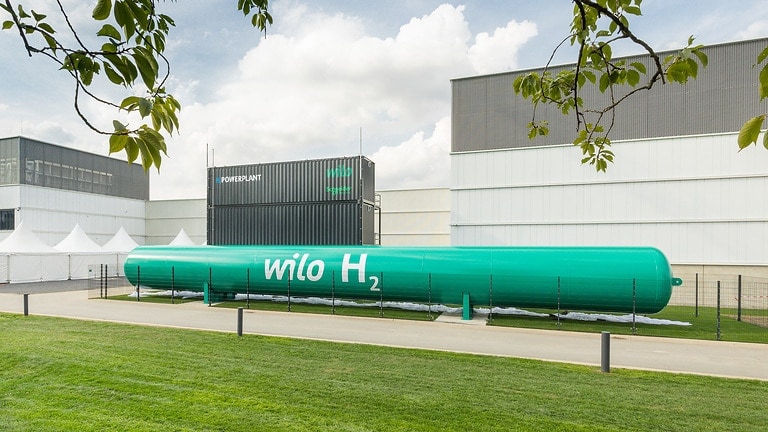
Hall A4
Spotlight Area Hydrogen
Wilo Hydrogen Solutions will show how hydrogen works as part of modern energy systems – from generation to integration into existing infrastructures. Practical, scalable and technically proven.
Experience how hydrogen makes energy storable, usable and economically usable.
From source to treatment – integrated, efficient and digitally connected
With digital monitoring and intelligent control, we enable resource-saving, energy-efficient and economical operation – UWWTD-compliant and future-proof.
- Raw water extraction: Reliable supply, flexible and energy-efficient pumping
- Drinking water transport & treatment: transporting water safely and reliably
- Wastewater collection & transport: Renewing infrastructure and modernising pumping stations
- Wastewater treatment: Upgrading sewage treatment plants and saving energy costs
- Urban drainage: Well thought-out sewer network control
- Digital Solutions – Water AI: Harnessing Data. Increase efficiency. Minimize risks.
Wilo Speaking Waters - AI for predictive water management
With Wilo Speaking Waters, Wilo brings Artificial Intelligence directly into the operation of municipal water and wastewater networks for the first time. As an AI-powered building block of the Wilo WATER AI Platform, the solution continuously analyses operational data, detects patterns and identifies anomalies such as leakages, pressure deviations or changes in water quality at an early stage.
Going beyond conventional monitoring, Speaking Waters transforms data into actionable insights. The AI provides concrete recommendations to support operators in day-to-day operations as well as strategic decision-making. Digital twins enable the simulation of different scenarios, allowing measures to be evaluated and prepared safely in advance.
The technological foundation is Wilo’s strategic partnership with AI specialist InstaDeep, jointly developing scalable AI modules for resilient, critical infrastructures.
Experience at IFAT how water data starts to speak.
Request more information about Wilo Speaking Waters
Our presentations at IFAT
You will experience professional impulses on water resilience, energy efficiency and digitally controlled infrastructures:

Blue Stage | Hall B2 | 04 May
Matthias Pantze, Global Director Water Management & Industry
The potential of WATER AI – The next level of smart wastewater pumping stations
Ageing infrastructure, climate change, rising solids content in wastewater and a shortage of skilled workers are pushing wastewater pumping stations to their limits. Smart pumping systems provide a solution: they enable precise, automated control, detect faults at an early stage and thus increase operational reliability, efficiency and transparency.
Wilo WATER AI stands for this new, data-driven intelligence in wastewater technology. The optimal interaction of pumps, sensors, control systems and management systems transforms wastewater pumping stations into resilient, future-proof hubs. Modular, scalable solutions can be seamlessly integrated into both existing and new installations – and precisely tailored to individual requirements.

Orange Stage | Hall A5 | 05 May | 09:30 a.m.
Thomas Fetting, Regional Director Circular Economy & Analysis
Panel Discussion: Circular Economy and Raw Material Security – Strategies for a Resilient Industry
A consistent circular economy can make a significant contribution to achieving climate neutrality while also strengthening raw material independence and long-term competitiveness.
In this panel, we will discuss practical pathways for implementing circular economy principles and present concrete best practices from DBU-funded projects in industry.

Hydrogen Stage | Hall A4 | 05 May | 10:30 a.m.
Richard Schmidt (Head of R&D Hydrogen Wilo Group) and Sevan Zadoyan (Key Account Manager Wilo Group)
Hydrogen solutions from Wilo
Wilo Hydrogen Solutions presents advanced technologies and systems for the efficient use of hydrogen across the entire value chain. Wilo shows how safe, scalable and sustainable infrastructures can support a future-proof hydrogen management. The presentation highlights Wilo’s role in the energy transition through smart products, digital connectivity and strong expertise in plant and infrastructure management.

Green Stage | Halle C4 | 05 May | 13:35 p.m.
Arne Schröder, VP Supply Chain Management Europe
Industry Insights – How sustainability works in companies
In a panel discussion, three speakers from different industries – such as water management, recycling, and logistics – will share concise insights into the circular economy and the reduction of resource consumption. In the subsequent joint discussion, these perspectives will be brought together and explored across sectors.

Green Stage | Hall C4 | 06 May | 12:30 p.m.
Rainer Rixen, Sales Manager Wilo Germany
Resilience over risk: Future‑proofing Europe’s water infrastructure
Extreme weather events, rising efficiency requirements and increasing pressure on resources are presenting fundamental challenges for water infrastructure. This presentation examines how resilient, energy-efficient and intelligently controlled infrastructure along the entire water cycle, supported by integrated solution approaches, can help to increase security of supply and minimise risks in the long term.